
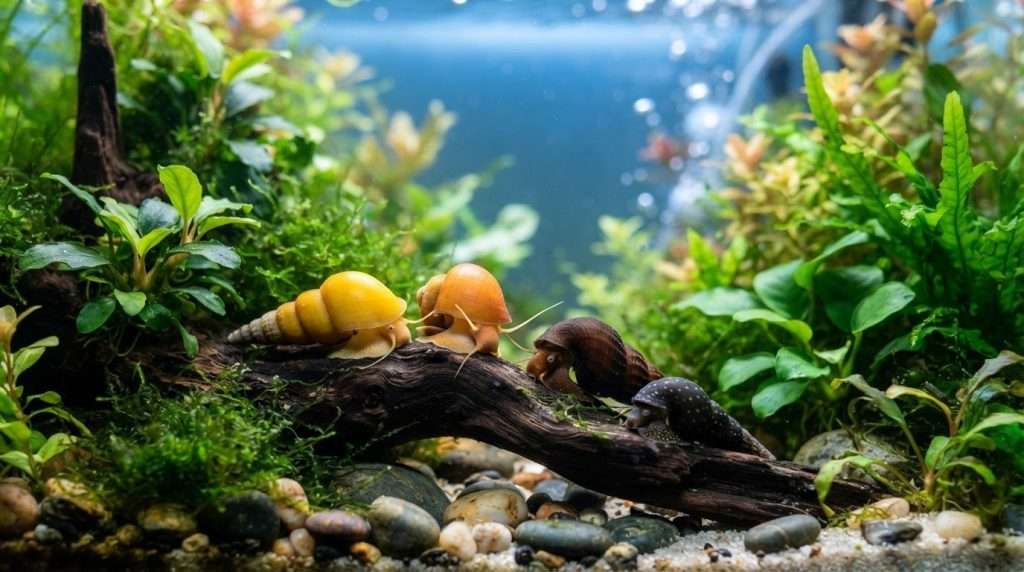
Rabbit snail types can be difficult to compare from photographs alone. Could the snail with the most striking colour be the wrong choice for your aquarium? Names used for rabbit snails can vary between sellers, and labels such as “yellow” or “golden” don’t always point to one clearly defined species. Colour is a useful clue, but it isn’t the whole picture.
If you’ve found photographs confusing, you’re not alone. Shell shape, surface markings and body colour can be subtle, while lighting can make the same snail look quite different. Comparing several visible traits gives you a more reliable starting point than choosing by a colour name alone.
This guide introduces popular varieties, including yellow or golden, orange, chocolate and spotted forms, and explains what to look for in their shells and bodies. You’ll also learn which aquarium conditions can help these warm-water snails thrive and how to consider compatible tank mates before choosing one. By weighing appearance alongside care, you can decide whether a rabbit snail suits the aquarium you’re planning.
Key Takeaways
- Distinguish scientific species names from trade names and colour descriptions to interpret labels more carefully.
- Compare rabbit snail varieties by shell shape, colour, pattern and visible body traits, not colour names alone.
- Separate appearance preferences from care needs when deciding which variety could suit your aquarium.
- Assess tank maturity, stable water conditions and grazing surfaces before choosing a rabbit snail.
- Use a simple selection process: read the label, compare observable traits, check care information and consider tank suitability.
What are rabbit snails, and why do their type names vary?
Rabbit snails are freshwater snails in the genus Tylomelania, recognised by their elongated shells and distinctive, rabbit-like faces. The name sounds precise, but it can describe several related snails rather than one clearly identified species. That makes variety labels tricky for new keepers: a colour name may describe a snail’s appearance without confirming its scientific identity.
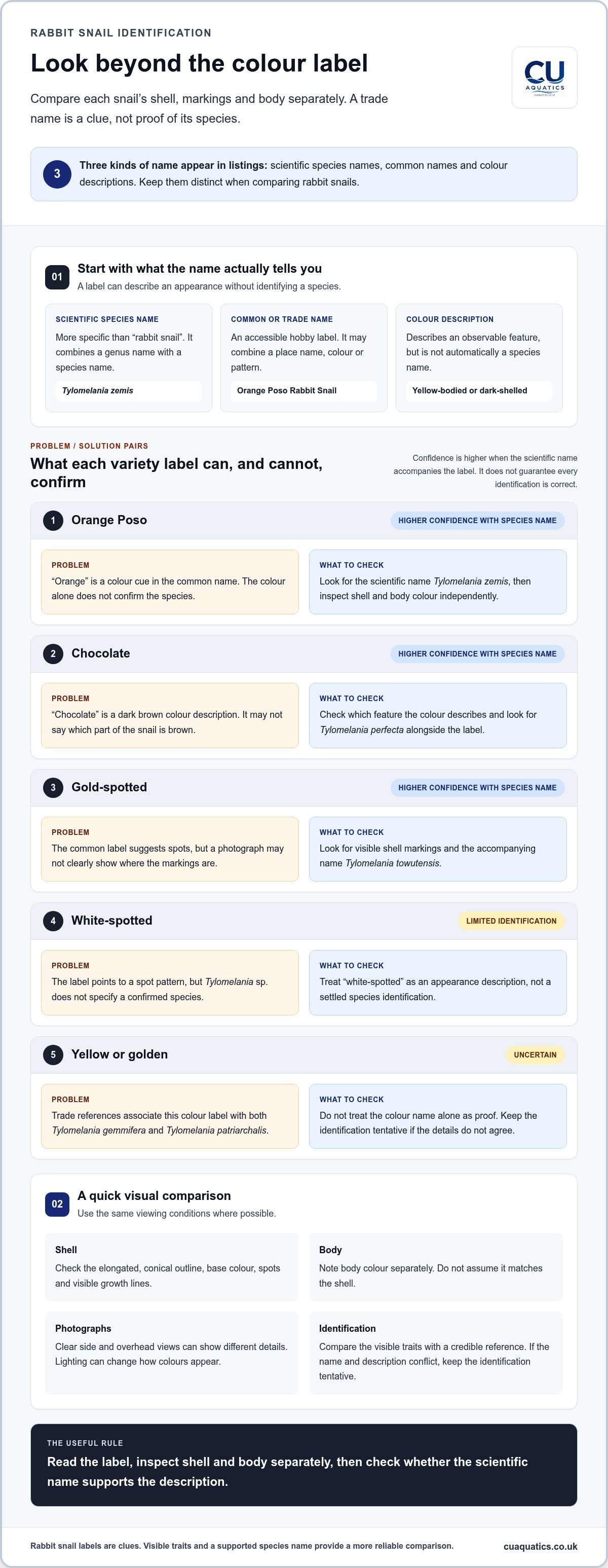
It helps to distinguish three kinds of names. A scientific species name, such as Tylomelania zemis, identifies a particular species, with the genus name followed by the species name. A common name, such as Orange Poso Rabbit Snail, is an accessible label used in the hobby and trade. A colour description, such as yellow-bodied or dark-shelled, describes an observable feature. It may form part of a common name, but it isn’t automatically a species name.
Are rabbit snails one species or a group?
They’re a group of related freshwater snails within Tylomelania, not one species simply offered in several colours. A scientific name is more specific than “rabbit snail”, while a trade label may combine a place name, colour or pattern. For a broad overview of the genus and its classification, see Tylomelania (Rabbit Snails).
Names in aquarium listings don’t always map neatly onto accepted taxonomy. For example, yellow or golden rabbit snails have been associated in trade references with both Tylomelania gemmifera and Tylomelania patriarchalis. Treat an identification as dependable only when the scientific name and visible description agree with reliable taxonomic information. Common names are a useful starting point, not proof on their own.
Why do rabbit snail variety names differ?
Trade names often highlight the most noticeable feature, such as shell colour, body colour or a pattern of spots. These cues can help you compare snails, but consider them separately. A dark shell with a pale body, for instance, describes two different visible traits. Lighting and individual variation can also affect how colours appear in photographs, so one image may not settle an identification.
A colour label alone doesn’t establish a separate species. It might refer to a recognised variety, a locally used trade name or simply an informal description. When comparing rabbit snails, look for a scientific name alongside clear notes about shell shape, shell markings and body colour. If those details are missing or conflict, keep the identification tentative rather than treating the label as conclusive.
These naming distinctions are useful when exploring freshwater snail choices more broadly. CU Aquatics groups its aquarium snails by category, and its gold mystery snail is a different kind of freshwater snail, not a rabbit snail. Keeping that distinction clear helps you compare livestock by identity as well as appearance.
Rabbit snail types: how to recognise the main varieties
Start with the whole animal, not the label. Compare the shell’s overall outline, colour and markings, then note the body colour separately. Rabbit snails share a recognisable elongated, conical shell, but a photograph may hide details or alter how colours look through lighting. A photograph or colour name can suggest an identity, but neither alone confirms a rabbit snail species.
The examples below are a practical starting point, not a definitive catalogue. Some labels are linked to a scientific name in aquarium references, while others remain broad trade descriptions. The identification confidence shown here reflects how clearly the label maps to a named species. It does not guarantee that every snail sold under that name has been correctly identified.
| Variety label | Observable cues | Identification confidence |
|---|---|---|
| Orange Poso, Tylomelania zemis | Orange is the distinguishing colour cue in the common name; inspect shell and body independently. | Higher when the scientific name accompanies the label. |
| Chocolate, Tylomelania perfecta | Chocolate refers to a dark brown colour description; check which part of the snail it describes. | Higher when paired with the species name. |
| Gold-spotted, Tylomelania towutensis | The common label points to a spotted appearance; look for visible markings on the shell. | Higher when the scientific name is supplied. |
| White-spotted, Tylomelania sp. | A spot pattern is indicated, but the label does not identify a confirmed species. | Limited: “sp.” signals that the species is unspecified. |
| Yellow or golden | A colour label that may describe the animal’s appearance. | Uncertain: trade references associate it with both T. gemmifera and T. patriarchalis. |
Which shell and body traits help identify a variety?
Check whether the shell is long and conical, then note its base colour, any spots and visible growth lines. Record body colour separately rather than assuming it matches the shell. For a useful comparison, look for clear views from the side and above, with both shell and body visible. Similar lighting and angles make differences easier to judge.
How should common rabbit snail labels be interpreted?
Treat common names as clues, then compare them with a credible identification reference. “White-spotted” is an appearance label here, not a settled species name, while the yellow or golden label has inconsistent species associations. Don’t turn a colour difference into a species distinction without supporting identification. If you’re planning an aquarium community, consider compatibility alongside appearance.
How to compare rabbit snail varieties before choosing
A useful comparison separates two questions: which appearance appeals to you, and what can reliably be said about the snail’s identity and care? A vivid shell may make one variety stand out, but it doesn’t show whether its needs differ from those of another rabbit snail. For the labels discussed here, the available information supports appearance comparisons more clearly than variety-specific care comparisons.
| Label | Appearance to compare | Naming confidence | Care difference documented |
|---|---|---|---|
| Orange Poso, Tylomelania zemis | Orange colour description; assess shell and body separately. | Stronger when both common and scientific names are given. | No distinct needs established by the colour label. |
| Chocolate, Tylomelania perfecta | Look for the dark brown feature named by the label, and note where it appears. | Stronger when paired with the species name. | No distinct needs established by the colour label. |
| Gold-spotted, Tylomelania towutensis | Check whether the shell shows the indicated spot pattern. | Stronger when paired with the species name. | No distinct needs established by the colour label. |
| White-spotted, Tylomelania sp. | Compare the described pale markings with the visible shell. | Limited: “sp.” leaves the species unspecified. | Not enough information to establish a variety-specific difference. |
| Yellow or golden | Record whether the colour describes the shell, body or both. | Less certain: the label is associated with more than one scientific name. | No distinct needs established by the colour label. |
Which traits matter most when comparing types?
Prioritise details you can observe or check: the shell’s outline, its base colour, any markings and the body colour. Then consider how securely the label is tied to a scientific name. A listing with a clear name and a description that matches the animal gives you more to work with than a colour label alone. There’s no need to rank one variety as “best” unless it answers a specific preference, such as wanting a particular shell pattern.
Care suitability is a separate decision. A yellow shell and an orange shell do not, by themselves, indicate different water or habitat requirements. Unless reliable references document a difference for an identified species, plan around the needs established for rabbit snails generally rather than assuming colour predicts care. That way, an appealing variation won’t be mistaken for a care distinction.
How can you tell a rabbit snail from another aquarium snail?
Compare the animal’s overall form and identification details, not just its colour. A gold mystery snail is another freshwater aquarium snail, but sharing a broad category doesn’t mean its behaviour or care is identical to a rabbit snail’s. For a practical comparison, consider each animal’s documented traits and needs, and use reliable snail-care guidance to understand the different roles snails may play in an aquarium.
In short, compare visible features and naming confidence, then assess tank suitability using care information rather than appearance. If the label is vague, treat the identification as provisional and avoid assuming it represents a distinct species or a different care profile.
What aquarium conditions should you consider for rabbit snails?
A colourful shell is only part of a good choice. Before settling on a variety, check whether your aquarium can provide steady tropical conditions, established grazing surfaces and suitable companions. These practical factors matter more than shell colour and help you decide whether your tank is ready for a rabbit snail.
Does every rabbit snail type need the same setup?
Start with the care needs shared by rabbit snails rather than assuming that a yellow, orange or spotted form needs a different setup. The care guidance for these trade labels doesn’t establish separate requirements based on colour. A confirmed species may have specific needs, so use reliable, species-level information if it documents a difference.
Rabbit snails are associated with warm, alkaline water. The care ranges provided for them include a temperature of 27 to 30°C and a pH of 7.5 to 8.5. Use these figures as a starting point for research, not as a reason to make sudden adjustments. Check your aquarium’s existing readings and compare them with a reliable care source for the identified snail before choosing one. Stable water matters, so avoid adding a snail to a tank where conditions are still fluctuating.
Use this checklist to assess your setup:
- Tank maturity: Is the aquarium established, with consistent readings and surfaces where natural growth has developed?
- Water stability: Can you maintain warm, alkaline conditions without abrupt changes?
- Shell support: Is there adequate calcium available in the water and diet to support shell health?
- Grazing surfaces: Can the snail reach biofilm, algae and other natural food sources around the aquarium?
- Substrate: Is the base smooth or fine enough to avoid rough contact with the snail’s soft body?
These checks help you assess whether a tank is suitable in practice, not just on paper. Grazing opportunities can vary between aquariums, so don’t assume algae growth alone will provide everything the snail needs.
Which tank companions and foods deserve thought?
Rabbit snails are generally described as peaceful, but compatibility depends on the behaviour of the animals already in your aquarium and the conditions you can maintain for all of them. Consider whether tank mates might harass or compete with the snail, and assess the community as a whole instead of relying on a blanket compatibility claim. A calm temperament in one tank doesn’t guarantee the same outcome in every setup.
Plan for dietary variety as well as grazing opportunities. Algae and biofilm contribute to natural feeding, but the care guidance also recommends supplemental foods and calcium sources. For dietary planning for a Batman snail, use a rabbit snail nutrition guide and match the plan to the needs of your identified snail.
Choosing a rabbit snail type and planning your next step
A confident choice comes from matching a snail’s identity and documented needs to the aquarium you can provide. Appearance can guide your preference, but a vivid colour label isn’t a substitute for clear identification or care information. Follow these steps to turn variety descriptions into a practical decision.
A practical checklist before selecting a variety
- Identify the label: Note the common name and any scientific name. Compare both with a reliable reference, and mark the identification as uncertain if the names conflict or the species is unspecified.
- Compare visible traits: Check descriptions of shell shape, shell colour, markings and body colour separately. Look for details that match the animal rather than relying on a single colour term.
- Check care evidence: Find guidance that applies to the identified species. Don’t infer different care needs from a colour label unless dependable information documents a genuine difference.
- Assess tank fit: Consider whether your aquarium can maintain stable conditions and provide suitable grazing opportunities. Account for the behaviour and needs of existing livestock, too.
- Consider your experience: Choose an animal whose care you understand and can support consistently. If the identity remains unclear, pause rather than planning around assumptions.
A reliable description should help you assess more than appearance. Look for a scientific name where available, a clear account of which features relate to the shell and which to the body, and care guidance that corresponds to the named snail. It should also be transparent about uncertainty. A listing that uses “sp.”, for example, indicates that the species hasn’t been specified, so the label shouldn’t be treated as a precise identification.
Where do rabbit snails fit among freshwater aquarium snails?
Freshwater snails vary in form and care, so compare each choice on its own evidence. A long, conical shell may help you recognise a rabbit snail, while another snail may have a noticeably different outline. That visual distinction is useful, but it doesn’t tell you whether the animals share the same behaviour or aquarium requirements. Check those separately before combining livestock.
For these varieties, the clearest approach is to identify the name, compare observable traits, verify care information and decide whether your aquarium is a suitable fit. If a description doesn’t provide enough detail, treat that as uncertainty, not proof that two differently labelled snails are separate species. This measured approach keeps the animal’s welfare at the centre of your decision.
Make your next aquarium choice with confidence
Let your aquarium’s needs guide your final choice. A striking colour can catch your eye, but a well-matched snail is one whose identity and care requirements make sense for your setup. Keep your notes on the label, the traits you can observe and the conditions you can maintain close as you plan what comes next.
CU Aquatics is a UK retailer of tropical freshwater livestock, including aquarium snails. As you explore rabbit snail varieties, consider the wider community and how each addition will fit into a healthy, balanced aquarium.
Thoughtful choices and a suitable environment can help you create an aquarium that’s vibrant and comfortable for its inhabitants.
Our rabbit snail range includes the chocolate rabbit snail, the yellow rabbit snail and the orange rabbit snail.
Frequently Asked Questions
Are rabbit snail types different species or colour varieties?
Some labels refer to distinct Tylomelania species, while others describe colour or pattern without confirming a species. For example, a listing that gives a scientific name makes a more precise claim than one labelled only “golden”. Even a name paired with a species should be checked against a reliable reference, as common labels can be used inconsistently. Treat unclear identifications as provisional rather than assuming each colour is a separate species.
How can I identify a rabbit snail variety?
Compare the scientific name, shell form, shell markings and body colour rather than relying on one feature. Look for a side view that shows the shell outline and a clear view of the body. If photographs show different angles, check whether the written description fits each one. A label such as “sp.” means the species hasn’t been specified, so it can’t confirm an exact variety.
Do rabbit snails need the same care as other freshwater snails?
No. Care needs vary between freshwater snail groups, so don’t transfer advice from one kind to another automatically. Rabbit snails are tropical animals associated with warm, alkaline water, while other aquarium snails may suit different conditions. Before adding one, compare your tank’s temperature and water chemistry with guidance for the identified snail. Consider shell health and whether the aquarium can remain stable rather than making abrupt changes to match a target.
Can rabbit snails live with fish and shrimp?
They can suit a peaceful community, but compatibility depends on the individual tank and its inhabitants. Consider whether fish may nip, harass or disturb a slow-moving snail, and whether the aquarium offers enough space and food for all its residents. Shrimp are often considered suitable companions, but observe how the community behaves after introduction. Don’t assume a species is safe in every setup simply because it is generally described as peaceful.
What do rabbit snails eat in an aquarium?
Rabbit snails graze on algae, biofilm and detritus, but these natural sources may not provide a complete diet in every aquarium. Supplemental options include sinking pellets, algae wafers and blanched vegetables such as spinach or courgette. Calcium also matters for shell health. Offer suitable portions and watch whether the food is eaten, removing leftovers before they affect water quality. Don’t rely on a visibly algae-rich tank alone.
Are rabbit snails suitable for a beginner’s aquarium?
They can suit a newer keeper who can maintain the warm, alkaline conditions they need, but they aren’t right for every first aquarium. A recently set-up tank may not yet offer stable water or established grazing surfaces. Beginners should first learn to monitor water conditions, keep them steady and provide supplemental food. If you’re still establishing the aquarium, wait until it’s stable before considering a rabbit snail.
How can I tell a rabbit snail from a mystery snail?
Look at the shell’s overall outline and the animal’s proportions, not just its colour. Rabbit snails are known for their elongated, conical shells, whereas mystery snails have a more rounded, globular shell shape. Colour alone can mislead because both groups may have vivid variations. Compare shell form first, then confirm the snail’s name and care needs separately. Different appearance doesn’t mean you should assume identical behaviour.